- Call: +254 711 547299
- info@majestickenya.com

Planning Your First Safari in Kenya from the USA: A Step-by-Step Guide
Planning a Kenya safari from the US is one of those things that seems like too much work until you get started, and then it’s a series of choices that quickly whittles down. The most difficult aspect is not any one step. It’s knowing the order of what to do, since the internet will readily lead you into visa forums and packing lists before you’ve even decided on when to go.
So here’s a fairly good breakdown of how it works, as someone who has been through it.
Decide when
This is more important than people realize. Technically, Kenya is a year round destination, but the experience can change greatly from month to month. If you want to see the Great Migration (the one where the wildebeest cross the Mara River) then you’re in the right window, as it runs from July through October. But the Mara is beautiful outside migration season as well, and it’s quieter and cheaper.
The long rains are in April and May. Most people try to steer clear of those months. The November short rains are less intense and do not typically disrupt travel, but can make some roads challenging. Warm, dry, and good for wildlife in most parks January-March. June is kind of a sweet time of year before the migration crowds come.
Select your month first. It all flows from there.
Determine the type of travel you’re looking for
This is where many people get stuck, as there are many safaris in Kenya and the internet doesn’t do a good job of helping you distinguish them.
On the one end, there are budget group tours. Large vehicles, set routes, communal accommodation. They work. You’ll see animals. But it’s more structured and less personal.
At the other end, there are private, completely customized itineraries with a private guide driving just your group, small, and remote camps, and a schedule that is flexible to what you wish to do. Sure, it’s more expensive, but it’s a different safari experience. If you are going all the way from the US, and this is perhaps a once-in-a-decade trip, it’s a good idea to give careful consideration to which version you will end up wanting.
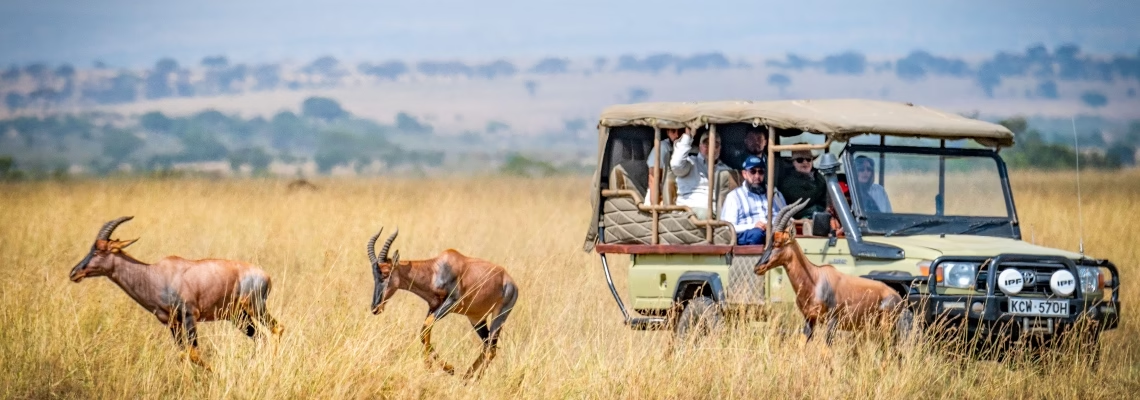
At Majestic Kenya Safaris, we organize private guided tours for travellers from the United States, taking care of the logistics, internal flights, and camp bookings, so you don’t have to do it all yourself from a different time zone. That’s the kind of discussion you should have early on if you’re not sure what type of trip is right for you, before you begin booking things individually.
Book early, Earlier Thank You Think!
The best safari camps in Kenya are small. Others have 8 tents. A few have four. The good ones sell out 6-12 months ahead during the peak season (July, August, September). If you are thinking of migrations safari and it is March, and you want to go in August, you are probably too late for the best camps, but there is always limited options.
Additionally, if you are traveling in the shoulder seasons (June, October, November), there is a bit more flexibility, but still 3-6 months is comfortable.
Even internal flights between parks are limited, particularly the smaller bush planes that fly to parks such as Mara, Samburu, and Laikipia. These aren’t jumbo jets. They’re 12-seater Cessnas and they get full first.
International flights
It takes about 15 to 20 hours to get to Kenya from the US, depending on the connection. There are direct flights to Nairobi, but they are limited. There are good one-stop flights from most major cities in the USA via Europe (London, Amsterdam, Istanbul) or the Middle East (Dubai, Doha) and a few airlines fly direct from JFK.
The European connections are the most popular among American travelers. Most people route through Heathrow or Schiphol. The Middle Eastern carriers, Emirates and Qatar in particular, are often more affordable and the layover airports are much nicer, though a bit longer.
One thing worth saying: book your international flight after, not before, your safari dates are confirmed. I have witnessed people booking a low-cost flight and then finding out that the camps they wanted are fully booked for those dates.
Visas
Kenya currently has an electronic travel authorization system, eTA. This involves an online application, payment of the fee, and approval prior to travel. It’s straightforward. Name, passport information, dates of travel, and a photo. Typically, the process takes 48 hours or less, but may take longer. Don’t leave it until the last week. Sometimes, things get flagged or delayed without any apparent reason, and you don’t want to face such hassles two days before leaving the US.
Besides, your passport must have a minimum of 6 months validity from date of entry. This is a strict rule and the airline will enforce it at check-in even before you get on the plane.
Immunizations and health supplies
If you are coming from or passing through a country where yellow fever is endemic, you will need to be vaccinated against yellow fever. It’s not required if you are flying direct from the US or through Europe, but some people do get it just in case. You should check the current requirements with a travel clinic to find out what is required since these things frequently change.
Beyond that, the standard recommendations are hepatitis A and B, typhoid, and a course of malaria prophylaxis depending on which regions you’re visiting. The Mara and coastal areas are higher risk for malaria than Nairobi or the highlands. A travel health consultation, ideally six to eight weeks before departure, sorts all of this out. Most major US cities have dedicated travel clinics and the appointments are quick.
Let me put it simply. Discuss this aspect with a doctor, not the internet.
Money
Kenya uses the the Kenyan shilling, although US dollars are accepted throughout the tourism circuit. Most safari camps use the dollar as their currency and will quote in dollars and want to be paid in dollars. Credit cards are accepted at larger lodges and in Nairobi, but cash only for tips, in most cases. Besides, once you’re in Kenya, you can get a temporary local Sim card (Safaricom is the best) and use their Mpesa service to make local payments, instead of carrying hard cash. Mpesa is widely used across the country, and it is relatively cheap to use.
If carrying cash, bring clean, fairly new U.S. currency. Older notes, particularly those dated prior to 2006, are sometimes rejected. Small denominations for tips, fives and tens mostly. Higher denominations for other purposes.
ATMs are available in Nairobi and larger towns, but do not work in the more remote regions where you will be spending most of your time. So ensure to withdraw within Nairobi, or other major towns.
Travel insurance
Get it. Not negotiable. Be sure it includes medical evacuation since if something goes wrong in the Mara or up in Samburu, you could be looking at a charter flight to Nairobi. Without coverage, that’s a would be very costly. Most safari operators require proof of insurance before they’ll confirm your booking, so this isn’t optional even if you wanted it to be.
Creating the actual itinerary
One of the most common mistakes that US travelers make is cramming too much. Kenya has numerous parks and reserves, and it is very easy to want to visit five or six of them in ten days or less. Don’t. Half the trip will be spent on the move and you will not be able to appreciate the places you visit due to lack of time and energy.
Most people find two or three areas over a 7 to 10 day period to be the sweet spot. The classic mix: the Maasai Mara for the big cats and the migration, Amboseli for elephants and Kilimanjaro in the background, and perhaps Laikipia or Samburu for something wilder and less visited. If you wish to unwind after the bush, include a couple of nights on the coast (Diani or Lamu).
This type of travel is possible with internal flights, which do not involve road days. Nairobi to the Mara takes an hour by plane, but six hours or more by road. The flights are more expensive, but they buy you time, implying that you can spend more time in the parks and reserves where it actually matters.
The final week before you leave.
Confirm everything including flights, transfers, camp reservations, and internal flights. Print copies of your eTA, insurance papers, and vaccination papers. Download offline maps of the regions you will be travelling to. Charge everything. Pack light. Soft duffel (15 kilos or less), no hard suitcase (on bush flights).
And then, honestly, stop planning. Close the browser windows. The most enjoyable moments of a Kenya safari are the ones that are not planned. The leopard in the tree which your guide saw from half a kilometre. The old Maasai man who escorted you through his village without your request. The roar of a lion in the middle of the night, at three o’clock, as you lay in your tent, thinking, “Did I really need canvas walls?
You can’t schedule any of that. You just show up.

Facebook
Twitter
LinkedIn
Email

Tracy Pelham
Tracy holds a degree in Travel and Tourism Management from the University of Nairobi and has over a decade of experience in the travel industry. Her expertise spans across international travel planning and personalized itinerary design, with a particular focus on luxury and adventure travel. Tracy has curated travel experiences for clients worldwide, and her insights have been featured in several travel magazines. She has also authored two guides on sustainable tourism practices.

Save up to 20%
We currently have an offer where you can save up to 20% if you book today.
Save 20%